
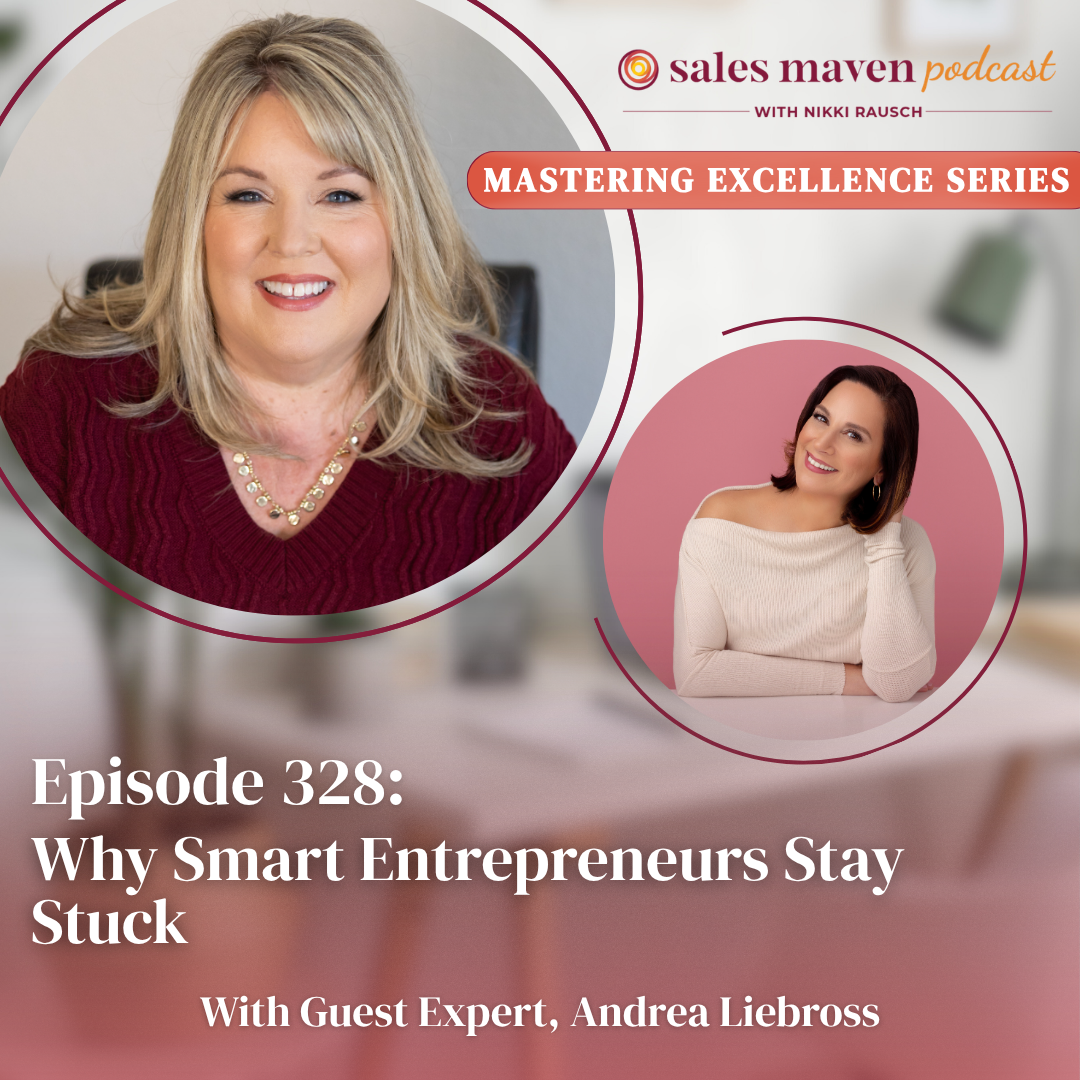
Why Strategy Fails Without Belief
What if the real thing holding a smart entrepreneurs business back is not your strategy, but your belief in what’s possible?
In this Mastering Excellence Series episode of the Sales Maven Show, Nikki Rausch sits down with business coach and strategist Andrea Liebross to explore the connection between belief, decision-making, and sustainable business growth for smart entrepreneurs.
Andrea specializes in helping women entrepreneurs who have hit a “success ceiling” uncover the invisible mindset and infrastructure gaps that keep them stuck, overwhelmed, or unable to scale. As the author of She Thinks Big and host of the podcast by the same name, Andrea helps business owners bridge the gap between belief and strategy so they can grow without constantly outworking themselves.
Together, Nikki and Andrea unpack why even the best business strategy will fail if you do not truly believe you can execute it or achieve the outcome you want.
This conversation dives into the importance of smart entrepreneurs stepping into the CEO role, increasing your risk tolerance, and learning how to move from what Andrea calls “stuck stress” into “progress stress.” You’ll hear powerful analogies around building belief bridges, creating the right support structure for growth, and making confident decisions even when uncertainty is present.
Andrea also shares how entrepreneurs can identify the thoughts that are quietly sabotaging their growth and how small mindset shifts can lead to major breakthroughs in business and life.
If you’ve ever felt stuck between wanting more growth and doubting whether you’re capable of achieving it, this episode will give you a practical and empowering perspective on how belief and strategy must work together.
In this episode, you’ll learn:
- Why strategy alone is not enough for business growth
- How belief acts as the infrastructure behind successful execution
- The difference between stuck stress and progress stress
- What it means to build a “belief bridge”
- How to increase your risk tolerance as a business owner
- Why clear, confident decision-making creates momentum
- The role of uncertainty in entrepreneurship and growth
A question to consider:
Where in your business might things be out of alignment?
And what would change if everything worked together instead of against each other?
If this episode resonated with you, be sure to subscribe and share it with someone who’s ready to strengthen their business foundation and increase their sales with intention.
Connect with Andrea Liebross:
Website: AndreaLiebross.com
https://www.andrealiebross.com/
Podcast: She Thinks Big
https://www.andrealiebross.com/podcast
https://www.youtube.com/@andrealiebrosscoaching/
Book: She Thinks Big
https://www.andrealiebross.com/books
Quiz: https://www.andrealiebross.com/quiz
Join the Society!
Nikki invites you to join the Sales Maven Society. Take advantage of this opportunity to work together with you and Nikki. Bring your questions, concerns, and sales situations; she provides answers and guidance. Join the Sales Maven Society here, click Join Today, and then checkout and use coupon code 47trial to get your first month for $47.00!
For more actionable sales tips, download the FREE Closing The Sale Ebook.
Chapters:
00:00 Introduction
03:16 Why Smart Entrepreneurs Struggle With Belief
07:08 The Bonfire Belief Analogy
09:20 Building a Belief Bridge
14:05 Belief vs Strategy Explained
15:28 Increasing Your Risk Tolerance
19:55 Stuck Stress vs Progress Stress
22:41 Real Business Growth Example
27:18 High-Value Decision Loops
31:58 Refining Business Offers and Growth
About Nikki Rausch
Nikki Rausch is the founder of Sales Maven, an organization dedicated to teaching entrepreneurs and service-based business owners how to sell in a way that feels authentic, relationship-focused, and effective.
As an accomplished sales strategist, speaker, author, and podcast host, Nikki has spent more than 25 years helping professionals improve their sales conversations, recognize buying signals, build rapport, handle objections, and close business without resorting to pressure tactics.
She is the creator of the Selling Staircase®, a relationship-based sales framework that helps business owners move prospects naturally from initial interest to becoming loyal clients. Nikki is also the author of the book The Selling Staircase and host of the Sales Maven Podcast, where she shares practical sales strategies, communication techniques, and business growth insights.
Whether she's teaching entrepreneurs how to ask better questions, navigate difficult sales conversations, identify buying signals, or increase referrals, Nikki's approach centers on creating genuine connections that lead to long-term business success.
Popular Topics:
Building rapport in sales conversations
Buying signals and closing techniques
Handling sales objections
Relationship-based selling
Referral generation strategies
Sales confidence and communication skills
NLP techniques for sales professionals
Ready to improve your sales conversations?
Explore Nikki's free resources, listen to the Sales Maven Podcast, or learn more about working with Sales Maven.
Read Full Transcript
Welcome, and thank you for listening to The Sales Maven Show. I'm your host, Nikki Roush, your own
personal sales maven here to offer you tips and strategies and techniques to master your sales
conversations. Today is part of the Mastering Excellence series, and that means I have brought a
guest on for you that is getting exceptional results in some area of her life and or business,
and we're going to dig into that today. And I'm very excited to introduce you,
if you haven't met yet, Andrea Libros. Let me tell you a little bit about her. She is a business
coach and strategist for the CEO who has hit a success ceiling. She specialized is,
is, sorry, let me redo that. Okay. It's okay.
Jeez. Andrea is a business coach and strategist for the CEO who has hit a success ceiling.
She specializes in identifying the invisible structural flaws, the gaps in conviction and
infrastructure that cause even the best strategies to fail.
Author of the bestseller,
She Thinks Big, and podcast by the same name, Andrea helps leaders stop outworking their doubt and
start engineering scalable growth that doesn't require more of their hours. If you're tired of
hitting the same revenue wall, head to andrealebros.com forward slash quiz to take the quiz that
reveals exactly where your business is leaking time and profit and maybe even belief,
which leads to our topic today. We're going to talk about how Andrea bridges belief with strategy
and the importance of how that shows up in your business. Andrea, welcome to the show. Thanks for
having me, Nikki. I'm so excited to have this conversation with you. Before we dive in, beyond the
bio, tell everybody a little bit about who you work with and the kind of work that you're doing in
the world and anything else you want to share. Yeah. Thanks for having me.
So I work with female
business owners who live really across the world. Everything I do is virtual. We do put a little in
-person in there. And these women, I really, I coach them to help them grow their businesses.
However, at the root of all of this, what I always go back to is you are a human and we need to
grow you in order to grow your business. So yes, we're here to grow the business.
We're in the business of growing businesses and scaling and creating whatever you want that
business to be or get out of the business, whatever that looks like. But at the root of it all is
you as the human. So I like to say everything is fair game. Life is fair game.
Business is fair game. It's all intertwined. And if you're not showing up as your best self,
there is no way that this business is going to grow no matter what we do.
That's kind of where I come at things. I love it. I love it so much. All right.
And we're going to talk today really about this idea of one of your superpowers truly is bridging
belief with strategy. Tell me a little bit more about what that means to you and why that's
important to be able to do that. Well, I see.
So many women and so many business owners, and myself can be included in this, right?
I am not immune to this. We really want a strategy, right? We want a strategy that's going to help
us navigate getting three kids out the door into soccer in three different parts of town.
We want the strategy for that, right? We also want the strategy that's going to bring in more
clients. We want the strategy that's going to simplify our back end of our business. But I really
feel like my superpower could be defined as bridging that gap between belief and strategy.
So you can only grow your business if you believe it can grow.
or you can have the best strategy in the world, but you've got to believe that it's going to work.
So where this shows up a lot is women not fully stepping into what I call the CEO role,
even if they don't feel like it yet. So if you own a business, you're the CEO. I mean, most likely,
right? You're in charge. And my clients usually come to me saying, that is the last thing I think I
am.
I guess I'm the CEO, but that is not what I'm putting on my signature. And then why?
So then I could go into why. Why isn't that in your signature? Well, I mean, I don't know.
CEOs, they're not the ones still standing on the ladders or they're not the ones that are still
doing all of these things. And then I kind of go to the place of. What do you believe a CEO should
be doing? Okay, so then everybody has their picture of that. And then, okay,
how do we get you to the place that that's what you're doing? Oh, I'm not sure that'll ever be me.
Really? Well, guess what? If you don't think it's ever going to be you, it's not going to be you.
So I like to say that belief is really… to be the infrastructure of your business,
right? It has to be the thing that's guiding all of your strategy and all of your next steps
because a strategic plan is really ineffective without the conviction to follow through on it.
So- I love this. There's, yeah. Okay. There's that. So the first question I usually ask in these
interviews is, if I was going to stand in for you for a day, lucky me, and I want to think like
you, I want to behave like you, what's my thought process when I'm starting to think about this
idea of bridging belief and strategy? Like, what comes to mind for you? Well,
I think usually people are coming to you, they'd come to a conversation with you and say,
here's what's going on. Right. Yeah. So they're giving you the backstory, the whole thing.
Right. So if you or me, you know, the first thing is I really try to do is to help people simplify.
Like we've got to get through what I sometimes call the messy middle. We've got to get through the
noise and really focus on what's happening underneath the surface.
You know, there's that. the whole theory of like seven whys, you know, why, why, why, why? So you
might be asking why with the intention of getting down to what's really going on.
And the whole reason someone's doing something or not doing something is because they want to feel
something or they don't want to feel something. And I think that's what we really have to get to.
That's what you would be working to try to get to. This is fantastic.
So if I may, just to comment to the audience here. So some of the stuff that I heard that you
commented on this idea of like, first and foremost, it's about simplifying. So that's getting
through the messy middle and what's happening below the surface. And really it kind of comes down
to these two key things. What do you want to feel or what do you not want to feel?
Yeah. What do you want to feel and what do you not want to feel? And that's guiding all of your
actions, right? So this kind of goes back to this belief infrastructure.
So I like to picture you as the flame, right?
So you're like… the thing in your business that's going to light it up,
right? So you're the energy in it. You're the ignition, okay? So if you picture a bonfire and
you've got that flame in the middle, well, what makes that flame go higher and higher and higher?
It's the structure around it, right? So it's the wood planks around it.
And that's really like what supports everything. So if you're not feeling,
like you can support that flame, the bonfire is not going to go too high. It's going to be pretty
low, right? If you're feeling like, yeah, I got this, even though I might be scared a little bit,
or even though this might be hard, whatever that is, in order to build up yourself or your
business, we've got to build up those wooden planks. We've got to build up the structure around the
bonfire.
That's going to help you get out of inertia or break through doubt or kind of spark,
spark some conviction that's going to create the momentum. So you would be, if you were me,
you're trying to kind of unpack the layers and see what's not working,
why you're not, why the bonfire isn't higher. Right? And then the next thing you'd really do is to
really help build up that scaffolding underneath. So yes,
we need some very tactical things, 100%. Because are you saying the scaffolding is part of the
belief or is it part of the strategy? Yeah, the scaffolding is really the belief, right? Like the
scaffolding is the belief. It's like an infrastructure though for the bonfire. Like the bonfire
can't happen unless we have that, right? Yeah. you know, sometimes people say, Andrea, you're like
an architect. So I am, I am trying to like get things put together or you're the general
contractor. Yeah. What do we really need in order to get this bonfire higher?
Right. Do we need to look at your finances? Do we need to look at your sales strategy? Do we need,
what do we need to look at? But you've got to believe that this, this buyer can become bigger.
Okay. So This is a little off script for me, but I feel like I have to ask this question now.
Tell me. So the question that comes up for me is when you're working with a client and you can tell
that there is some lack of belief, right? And so you can't really,
like, what do you do then? If she doesn't believe it, what do you do then?
Well, I think you've got to figure out, then you've got to… two things. Number one, you can build
what I call a belief bridge, which I'll explain to you what that is. But number two,
and let's just start with number two, what do they think is possible, right? That's going to help
you get to what I call the next best step. Okay. So you've got to figure out where is your minimum
baseline? Like what, what is possible? Okay. In your mind right now.
And if we look at your priorities, if we look at your belief, right?
And if we look at the facts, so I kind of say like A plus B plus C equals your next best step.
Okay. So we can start there. Facts, belief, priorities,
equal next best next step. Now, if you want to go, you know, elevate this.
right? We have to build what I call is a belief bridge. Are you familiar with this at all?
No. I mean, in my mind, I feel like, oh, I know I can make sense of this, but I really just want to
hear it from, I want to hear from your mind. Okay. So I like to say,
well, you know, person out there, you might be floating down the river of misery right now.
So there's a river, it's called the river of misery. Okay. And I know it's sad. And there's two
banks of the river. There's the land of impossible on one side of the river. And then there's the
land of possible on the other side of the river. And there's a little wooden bridge with planks
that goes over the river. Okay, so whatever this idyllic little picture is.
And each of those planks represents another step of the bridge.
That's going to get you from the land of impossible, which is on one side.
Actually, I misspoke. The land of impossible on one side to the land of inevitable on the other
side. So there's impossible and then there's inevitable. And in the middle is possible.
At the little peak of the bridge, that's where possible happens. Okay. So each of these planks
represents a thought,
right? So you might have a thought. There is no way I am going to obtain five more clients this
month. Okay. Like it's impossible. There's just no way. All right. Next thought.
Well, I do think that one is possible. So that's like the next step on the bridge.
Next, then step two or plank two, little wooden plank two. If I put out…
more, and we can, you know, is this ads? Is it emails? Is it made offers?
Is it got in front of more people? Whatever that is. All right. Maybe two is possible.
Two new clients. Okay. All right. Then what's the next? So you've got to really go through your
head and figure out what are the thoughts that need to happen in order for you to move from
impossible to possible to inevitable. Right?
So sometimes I use the analogy of like losing weight. There's no way I could lose 10 pounds before
July 4th. Okay. But that's an original thought. And the next thought is,
well, I do control what goes in my body. Okay.
Next thought. There are some things that would be help me lose weight versus help me not lose
weight. I know what they are. They're accessible to me. I should just purchase those and put them
in my refrigerator. Then I can stick to that. Also, I know exercise might help. So you're just like
moving yourself through impossible to possible to inevitable.
That's a belief bridge. And there's no zip line from one.
There's no zip line. Here's the bad news. No zip line from one riverbank to the other.
Okay. But if you're floating down this river of misery, you can put on some life jackets,
okay? So that you don't drown. Yes. And, you know, I like to say, who's going to support you in
this? That could be a life jacket, right? How can you make, how can you figure out how to make this
easier? That's a life jacket. Like you're in charge of your destiny here, right?
And you may need help. getting across this belief bridge. You may need to put your life jacket on.
You may need someone to throw you a rope, but you can do it. So there's this belief bridge,
which is much more mindset-based, right? And then there are literally the tactical next steps.
So here comes the strategy. Yeah, so here comes the strategy, right? So it's not like this is all
just about manifesting because that's not me at all. In fact, most people would say I am like tough
love with a smile and I tell it like it is and I'm pretty direct. But I do believe,
but I do believe that the belief is a…
Part of this and helping you grow that literally and figuratively is,
is one of my superpowers. This is fantastic. I love an analogy.
I have such a clear picture in my head of these different planks. I love to,
that there's like, there's no zip line, right? It's like one at a time and understanding that you
can start with a belief and have some shifts. And they can happen,
but it takes some, you know, it takes some work, right? To have these shifts in your thought
process. And then once you start to make some shifts, that's where strategy comes in. So this,
I love this. This makes so much sense to me. Okay. So my next question is this idea of like,
what is the real goal behind bridging belief with strategy? When you think about this,
either in your own business or when you're working with your clients, what would you say are the,
and it could be more than one goal, but like the goals, like what are those? Well, one goal is to,
I would say, assess and probably increase your risk tolerance. Because I don't know about you,
but I don't know anyone that's really, you know, has a bonanza business,
right? That hasn't taken some risks.
Yeah. There's some risks out there. And everybody always wants to go to,
this is kind of like neuroscience, actually. You and I were chatting about that before we hit
record. You know, there's something in our brain, like the motivational triad. We want things to be
safe, efficient, and enjoyable. That's,
you know, that's back to the cavemen. The cavemen wanted to be safe. They wanted to be there
hunting and gathering and to be efficient. And they loved pleasure. Okay. So. We're still wired
like that. And intertwined in that is not really like,
let's take some risks, okay? So I think the ultimate goal here is to help you figure out where your
risk tolerance is and probably increase it. And then the other thing is to help you make clear,
confident decisions,
right? Part of the goal here is that you can move things along,
both yourself as a human and the business, right? By making clear,
confident decisions. So I do work a lot with my clients and helping them create some frameworks and
filters around creating, making clear, confident decisions. Because that's not always easy.
And we always want to go back to, I want to make the right decision.
Okay. I'm sure you've heard lots of people say that. And we say it ourselves, right? I just,
usually there's a just in there. I just want to make the right decision. Yes. Okay.
Or I want to be smart about this. Or I need to think about this a little bit before I move forward.
Okay. So if someone says that, I always go to like, well, can I ask, can I put my coach hat in for
a minute? Sure. What exactly are you thinking about? You know,
I'm going to sleep on it. Okay. What exactly are you thinking about? No one has a great answer to
that question, right? Because what's really going on, what they're really thinking about is that
they're trying to become more comfortable with whatever decision they really,
really want to make, right? They want to go for it, for example. Okay. But they're not sure if they
have the funds or, but they don't know if they have the time. But, right,
there's always the buts. And that's you trying to become more comfortable with the decision.
So if I can help my clients make clear, confident decisions,
and when I say increase your risk tolerance, I mean, we could talk about that on a very big scale,
but being comfortable with being uncomfortable. Right.
That's, that's really what this risk tolerance thing is about. Like embrace, sometimes I call it
embracing the unknown or embracing uncertainty. And, um, you know, I wrote this book called She
Thinks Big and the name of my podcast is She Thinks Big. And so sometimes people say, well, what is
a big thinker, Andrea? And I use the word trust as a, an acronym,
but. The you in trust stands for embracing the unknown or uncertainty.
Like you've got to get to the place where you're okay with that. You don't have to love it, but you
gotta be okay with it. Which I think that speaks to, you have to be able to increase your risk
tolerance, right? Yes. Yes. So it's all intertwined, right? To be uncomfortable, to be,
yeah. And so. And if you think about that bonfire too, it's like. Should we put another layer of
logs on there or is like the whole thing going to crumble, right? Should we continue upward or not?
Like that's a little risky too. Yeah. Okay. So just to speak here,
some more structure I think that came out here is when you think about the goals around bridging
this idea of belief and strategy, it's about increasing risk tolerance. That's one.
And two, it's about being able to make clear, confident decisions. And I think maybe I'm just in my
own brain thinking like, okay, when I feel really confident and clear about my decisions,
like even if there's risk involved, like. there's still, there's like a level of excitement to
taking this next step, right? Or like being willing to try something that feels new or
uncomfortable or change. Correct. You got it. Yeah.
And I think that also, if I could throw something else in here, it's probably helpful.
I talk about this concept of stuck stress versus progress stress.
Okay. So When we are in stuck stress,
it feels really heavy, right? It feels heavy.
You're stuck, literally. You're frustrated. You ask yourself all of the what if questions that end
in things that aren't great. You know, what if this doesn't work? What if I don't have the funds?
What if the revenue doesn't come in? What if the person I hire isn't the right person? Okay.
You're confused.
You're frustrated. You're probably going around in circles. You're asking what if questions.
That's all stuck stress. You've got to shift into what I call progress stress because like the
whole world is not rainbows and daisies here. So it's like you just said, okay, when you make that
clear, confident decision, even though there might be some risk in it, you're excited. Okay.
So there's still some apprehension. There's a little stress and anxiety. But when you shift into
this progress stress, you are moving quickly. You're moving forward. You're answering the what if
questions with what if this works? What if this is the best decision I've ever made?
What if I'm not only going to make $100, I'm going to make $100. So you start to create some
momentum. You're fueling yourself with curiosity, okay?
And I am not gonna tell you that like living on this planet is not stressful because it is,
right? But if you can move forward with this progress stress, you're gonna get a whole lot further.
And in my book, there's this whole diagram of stuck stress and progress stress. And it kind of
shows like the stuck stresses, all these like kind of like a ball of yarn all tangled up.
And the progress stress is not a straight line and nor is it like an arrow upwards,
diagonally upwards, right? It's a little lazy. You know, they always say like entrepreneurship is
like a roller coaster. It is, but you're moving. You've got some movement. This is so fantastic.
I haven't heard anybody talk about this stuck stress versus progress stress and to be able to
identify where you are. And so when, you know, when. I'll just say this to me,
like when I find myself in this place of it feels heavy, I'm frustrated to have this new term to
say, Nikki, this is struck. Excuse me. This is stuck stress. Like,
yeah, it's so helpful. Right. So, you know, going back to your, one of your original questions, if
you were me, you know, a lot of times I'm just helping my clients identify, okay, are we in stuck
stress here? Or are we in progress stress? And usually they're in stuck stress,
but we can shift it to progress stress. I'll give you an example.
Okay, I have a client. She owns several salons. Okay,
so she's a salon owner, multiple locations, and she wants to add an additional location on. And
this property became available in… a different neighboring town where the client,
the people that live in that town, it's more renters. It's a little more transient. It's a little
more like urban and the other salons are in much more established suburbs.
Okay. But this location, this location is like turnkey.
It's already built out as a salon. Okay. So there's not a lot of build out that needs to happen.
There's not going to be a lot of out front, upfront money that needs to go in there. And I get, but
she's like, yeah, but I don't know. Right. So I said to her, what if your next location is totally
different than the other two? What if the clientele are maybe a younger,
more apartment dweller type clientele?
What's so wrong with that? And isn't it great that you don't have to put in all this money to do a
build out? Because in the past lunch, she's put in a lot of money to build out. I said, I think you
should go check it out. I think you should, maybe you should go for this. And so all of a sudden
her stuck stress of, should I even go look at it? Or I'm not sure this is the right town or just
sort of like swirling shifted into progress stress. Okay.
And she kind of said to me on, I use Voxer a lot. She's like, I love Voxer. Okay. Voxer.
I use Voxer a lot. So we're kind of almost having a real time conversation in this with maybe like
five minutes in between as I empty my dishwasher, you know, whatever's going on. She said,
I feel like you just gave me permission to actually explore at a deeper level this opportunity.
And I said, yeah. She's like, it still seems a little scary, but. I'm going to go check it out. And
so she did go. And actually last night she checked out the property and messaged me this morning.
How was it? She's like, well, it's not the space for me. She's like,
the space didn't feel right. But I'm so glad I went and looked at it because now I have this whole
other perspective on maybe what this next location is going to look like. So she's totally,
she's definitely shifted out of that progress stress. or sorry, sex stress into progress stress.
And she shifted her belief that all these locations have to look and feel the same. Because she
really was believing for a minute that they all had to kind of be the same exact type of client.
And now she's like, no, they don't. They don't need to be the same exact type client. Maybe it's
great that it's going to be different. Yeah. So that's kind of an example. I think that is so
powerful. And I feel like I can feel this in my body as you're like explaining this,
this idea, like I know what the difference is, what it feels like to be in stuck stress versus in
this progress stress. And that is just incredibly helpful. And to have somebody like you who can
help somebody identify that and then make that shift. like such a powerful,
incredibly helpful guide in those moments. So you get, you get good at it.
Like you get better at it. This is a, it's almost like a skill, right? And then you start,
my clients start to be able to identify like, oh yeah, that's that.
I don't, they don't stay in that stuck stress for nearly as long. Yeah. Yeah.
Which is freedom. Like that's what comes to mind for me. It's like there's freedom in that. And I
say, I don't know if you've talked about this, but I say there's our four most valuable resources
are freedom of time, money, people, and energy,
right? So we want freedom in all of those categories. And if we can create that for ourselves by…
our belief, increasing our risk tolerance, making clear, confident decisions, shifting out of the
stuck stress into progress stress.
We go places. Yeah. Yeah. So good. All right.
So I usually like one of my last questions just in these NLP questions to be, so how do you know
when you've achieved the goal that you're bridging your belief with strategy and it's time to stop?
Hmm. Interesting. Okay. So time to stop moving,
like time to stop on this pursuit. Is that what you mean? Or time to stop? Well, I really, I want
you to add the meaning to it. That's kind of the, so whatever comes to mind is perfect for you.
Okay. So I think there's two things that come to mind.
Number one for someone, like two personas. If someone's like,
okay, it's time to stop moving forward on this initiative. I'll call it. right?
Like this is no longer a good idea or this no longer, I'm not, I really don't think this is going
to work. My belief is it's not going to work. Yeah. Like your example of your client last night,
right? Yeah. That's a good example. Yes. Perfect. All right. So she's going for, she's going to
have another location. That's not our question here. It's just like, what's it going to be? Okay.
Perfect example. So I call that like the loop de loops.
So picture like you're doodling and your pencil's like making one loop and then you make a bigger
loop and then you make the next loop, okay? So it's just one cycle or one loop in the process,
in our pathway of life, in our business trajectory, okay? So,
and actually each of those loops… includes a couple of different elements.
They're all the same different elements. You start out with the belief, you take some action,
you make a plan, you take some action, and then you assess, right?
So you start out with some belief, you make a plan, you take some action, and then you assess.
And each of these things is just like the next loop, just the next loop, okay?
And that assessing or tweaking or honing what you're doing,
is a signal like ready for the next loop. I'm going to stop this one and I'm ready for the next
one. So there's that sense of it. And I think that's healthy, right?
And I call that like a high value cycle. When you know it's time to stop, like the cycle is not
necessarily over, but it needs to change. So sometimes I picture this as a clock too.
It's like you started at 12. At one o'clock, you're like, all right, I'm going to move forward.
At four o'clock, you've got your plan. At six o'clock, you put it into action. At nine o'clock,
you start to assess. Eleven o'clock, you tweak it,
you hone it, you shift a little, and then you're up at 12 again and you go again and it might look
a little different. But they're high value cycles versus low value cycles. Low value is like you
throw it out the window and you say, forget it. And you go all the way back to zero. So I don't
think we ever should really go all the way back to zero. We're either learning or winning, I call
it.
So there's that piece of it. Then the other thing that popped into my mind is there comes a
point where maybe this business, this relationship,
era is ready to come to a close, right? And I call it like you have lived out the life of the
relationship or the life of the business. And that's okay. That's okay.
It just means that you're ready for something else, right? So it's kind of the same loop-de
-loops, but instead of your business going through this, it's you. And that happens to everybody.
I mean, even my daughter, I have two kids, my youngest one graduated from university this weekend.
Congratulations. Thank you. So I sat there in the audience looking out and I'm not very emotional,
but a tear did come to my eye because I was like, oh, it's the end of an era, right?
It's just the end of an era. Like no one's in school. I have two employed children who are living
on their own, right? Or soon to be. So like my belief didn't change there.
Right. Like my belief in them didn't change, but my belief a little bit on like what my role in it
kind of did is changing. Yeah. So anyway, this is so great.
Okay. Yeah. Thank you so much for taking this time. Before I wrap up, I usually like to ask some,
some more, like I call it the little something extra. Yeah. Ask me the little something. Let's do
it. So just so the audience can get to know you a little bit more and for me too, I find you
fascinating already. I have to say, I in no way could anticipate what your answers were going to
be. And it was so fun because you were just like, every time you had an answer to something,
I was like, oh, that's so good. So I just wanted to say that. Thank you. All right. So my question
for you is what brings you pleasure or joy right now?
Oh, well, I play golf. So it's golf season.
Okay. I'm getting good. We joke, this is the year. This is the year.
This is it. Okay. So that actually does bring me a lot of pleasure.
I mean, I love being outside. I feel like I can solve all the world's problems on the golf course
with the people I'm playing with. We have some great conversations and it's a good skill.
Anyway, so there's that. That's bringing me joy. And I think I'm actually really kind of thinking
about this next. like era of my life is, I'm excited about it.
And what's ahead, we'll call it. So I feel like we've been empty nesters here for a little while
because they're, you know, kids have been in college or whatever, but, you know, we can do whatever
we want.
Freedom, freedom, right? Yeah. All right. How about what's something exciting going on in your
business right now?
That is good. I am refining and fine tuning my offers.
So I've been at this for eight years and there's been lots of variations of my offers,
right? I'm sure like everybody. Yeah. But I'm very excited for what will be rolling out in the next
month or so. They're tweaks, same structure in general.
But I really feel like this is, I'm going to be able to serve. Two different people at two
different places and stages of their business. So it's not really,
I think this is the other thing is I think I've finally hit upon when people say,
describe your ideal client. And a lot of times they go to revenue, right? Like what's…
But because I'm industry agnostic, like I've got people that are in all sorts of industries,
revenue sometimes isn't the best indicator of who needs what. It's more about where they're at in
their thinking or where they're at in what they want next for themselves and their business.
And I think I've kind of gotten that down. So I'm excited to share. That's fantastic.
All right. Last question is for somebody listening right now who wants a little more Andrea in
their life, what are the best ways to connect with you? The best ways?
Well, I have 270 something podcast episodes out there. So you can go listen to those.
My podcast is called She Thinks Big or get yourself a copy or listen,
Kindle. hard copy of my book, She Thinks Big. But on a daily basis, you can find me on LinkedIn and
Instagram, and I'd be happy to chat. Send me a message. Tell me you heard me on Nikki's podcast.
Last way, if you're kind of curious, like what's getting in your way, if you're curious about the
stuck stress and this progress stress and how to shift, go over to my website, andrealebros.com
forward slash quiz and take the quiz. And I sort of reveal what I call the silent saboteur.
So like what's sabotaging you, but kind of silently. Because a lot of what we talked about today is
not overt, right? It's not. It isn't really showing up sometimes.
I mean, I guess this is in data. I mean, it is showing up in data if we dig deep, but it's not
always the easiest thing to put your finger on. But I think it is so necessary.
Like what you do, so necessary. People, I mean, they've got to perfect those skills. And I feel
like this is just the… the anecdote to that, like how they're together.
What I do and what you do are very much aligned, just different pieces of the puzzle.
Yeah. Yeah. Well, thank you so much for saying yes. And I learned so much from you today.
I know that the listener is going to feel the same. And I just, I'm very grateful that you said yes
and that you shared so openly on the podcast. So thank you. Thanks for having me. Yeah. And for
you, the listener, as always, thank you so much for being here. And Please share. What was your
takeaway? What was your big takeaway from this episode? For me, there were so many great ones,
but I'll say this stuck stress and progress stress blew my mind.
So I want to hear from you. What was yours? All right. And I am wishing you continued success in
all you're doing. And thank you so much for listening. Have a great rest of your day.


